

Luang Prabang Travel Guide: Everything You Need to Know Before You Go
Luang Prabang is a UNESCO World Heritage city in northern Laos, built on a narrow peninsula where the Mekong and Nam Khan rivers meet. For centuries it was the royal capital of the Lao kingdom — a city of temples, monks, and river trade that the 20th century largely left intact. Today, it is one of the most atmospheric small cities in Asia: a walkable grid of French colonial shophouses and gilded Buddhist temples, where the sound of monks chanting at dawn still defines the start of every day.
This Luang Prabang travel guide covers everything you need to plan your visit — best time to go, how to get there, what to budget, how to get around, and the local knowledge that separates a meaningful visit from a rushed one.
Luang Prabang at a Glance
| Detail | Info |
|---|---|
| Location | Northern Laos, at the confluence of Mekong and Nam Khan rivers |
| Altitude | ~290 m above sea level |
| UNESCO status | World Heritage Site since 1995 |
| Best for | Temples, monks, Mekong, waterfalls, slow travel, craft traditions |
| Best time to visit | November–March (cool dry season) |
| Average daily budget | $30–$55 (mid-range), $80–$180 (comfort) |
| Minimum stay | 3 nights (4–5 nights recommended) |
| Currency | Lao Kip (LAK). 1 USD ≈ 21,000 LAK (2024) |
Best Time to Visit Luang Prabang
Luang Prabang has three seasons: cool dry (November–February), hot dry (March–May), and wet season (June–October). The best months are November, December, and February — clear skies, temperatures of 20–28°C, and the low humidity that makes walking between temples genuinely comfortable. January can be slightly cooler (nights drop to 15°C) and is the quietest month for crowds.
March and April are hot (35°C+) and dusty — haze from agricultural burning can obscure the mountain views. The wet season (June–October) brings lush green landscapes and the Mekong at full flow, but roads to outlying villages can be difficult and the humidity is high. The wet season is also significantly cheaper and sees the most authentic local festivals.
Month-by-Month Summary
| Month | Weather | Crowds | Verdict |
|---|---|---|---|
| Nov–Dec | Cool, dry, clear | Medium–High | Excellent — peak season with good reason |
| Jan–Feb | Cool, dry, clear | High (Feb) | Excellent — Jan quieter, Feb for Lao New Year lead-up |
| Mar–Apr | Hot, hazy, dry | Medium | Acceptable — Pi Mai Lao (Lao New Year, April) is festive |
| May | Hot, first rains | Low | Good value, green season begins |
| Jun–Sep | Wet, humid, lush | Low | Budget travel, authentic festivals, some road closures |
| Oct | Wet ending, cooling | Low–Medium | Good — Mekong high, Ok Phansa (end of Buddhist Lent) festival |
How to Get to Luang Prabang
Luang Prabang International Airport (LPQ) receives direct flights from Bangkok, Chiang Mai, Hanoi, Vientiane, and several other regional hubs. Flying is the fastest option; the town is also reachable by the new Laos–China high-speed railway from Vientiane (opened 2021) and by the legendary two-day slow boat journey from the Thai border at Huay Xai.
Getting to Luang Prabang: Options Compared
| Route | Method | Duration | Cost (approx) |
|---|---|---|---|
| Bangkok | Direct flight | 1h 40min | $60–$150 |
| Chiang Mai | Direct flight | 1h 10min | $50–$120 |
| Hanoi | Direct flight | 1h 15min | $50–$130 |
| Vientiane | Flight or Laos–China train | 1h (flight) / 2h (train) | $30–$80 (flight) / $25 (train) |
| Thai border (Huay Xai) | Mekong slow boat | 2 days | $50–$80 incl. guesthouse stop |
The Mekong slow boat from Huay Xai deserves special mention. The two-day downstream journey from the Thai border — on wooden passenger boats carrying a mix of travellers and local cargo — passes through remote river valley scenery with no road access. It is one of the classic overland journeys in Southeast Asia and the best possible introduction to the Mekong river culture surrounding Luang Prabang.

Getting Around Luang Prabang
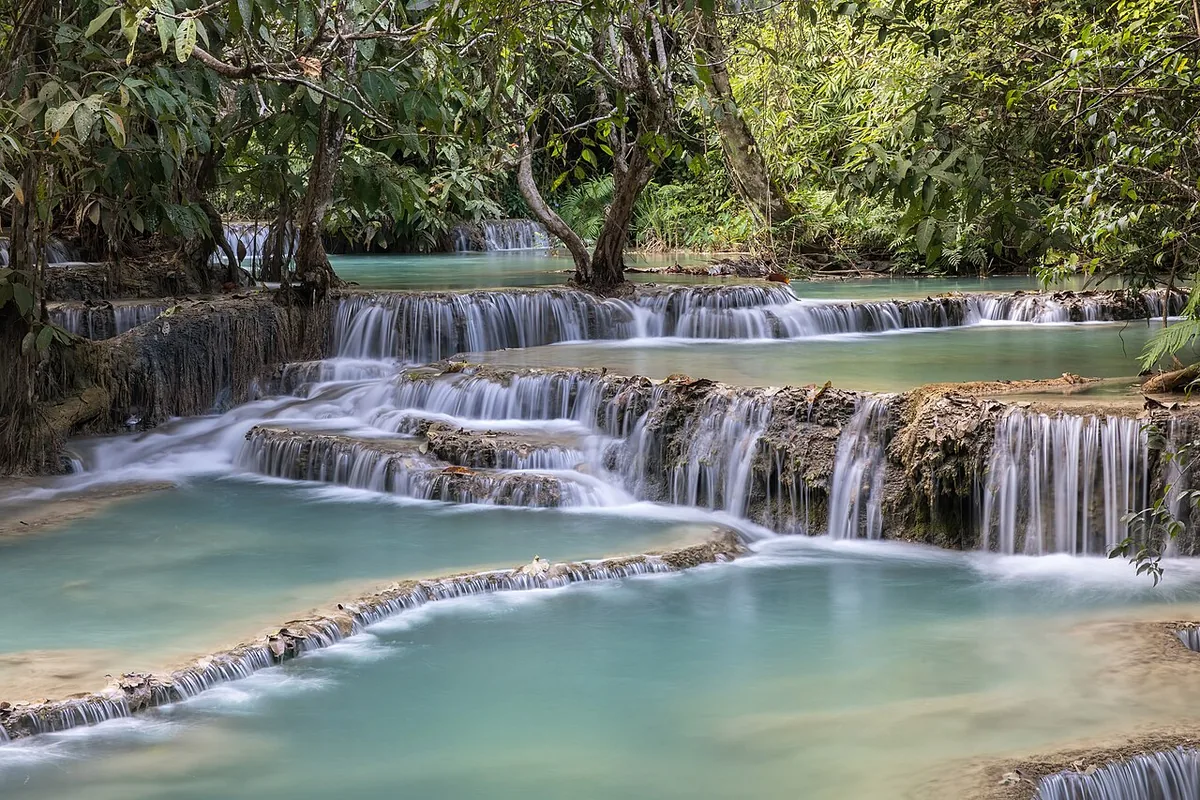
The Luang Prabang peninsula is compact and almost entirely walkable — most temples, restaurants, and guesthouses sit within a 20-minute walk of each other. For the riverside villages, Kuang Si Waterfall (29 km), and the Pak Ou Caves (25 km upstream), you need transport.
- Bicycle — Best for exploring the peninsula and the riverside villages (Ban Xang Khong, Ban Phanom). Hire: 20,000–40,000 LAK/day ($1–$2). Flat terrain throughout the town centre.
- Electric tuk-tuk — Luang Prabang’s signature green electric tuk-tuks are available throughout town. Good for short trips and night rides. Negotiate price before boarding: 20,000–50,000 LAK per trip.
- Minibus to Kuang Si — Shared minibuses to Kuang Si Waterfall run from the tourist information office near the main market. Cost: 50,000 LAK each way. Departure: 8:30 AM and 9 AM.
- Longtail boat — For Mekong boat trips to Pak Ou Caves and upstream villages. Negotiate at the main pier (Ban Wat That pier) the evening before travel.
- Motorbike hire — Available for $8–$12/day for exploring further afield. International driving permit required.
How Much Does Luang Prabang Cost?
| Category | Budget | Mid-Range | Comfort |
|---|---|---|---|
| Accommodation/night | $10–$25 | $35–$80 | $100–$350+ |
| Meals (local) | $2–$5 | $7–$15 | $18–$40 |
| Kuang Si entry | $3 (60,000 LAK) | $3 | $3 |
| Temple entry | $0.50–$1 | $0.50–$1 | $0.50–$1 |
| Bicycle hire/day | $1–$2 | $1–$2 | — |
| Daily total (estimate) | $25–$40 | $55–$100 | $130–$300+ |
What to Eat in Luang Prabang
Lao cuisine in Luang Prabang is one of Southeast Asia’s most underappreciated food traditions — herb-heavy, river fish-focused, and built around the sticky rice that Lao people eat at every meal. The dishes to try:
- Khao niao — Glutinous sticky rice, the Lao staple. Eaten with the hands, rolled into a small ball and dipped into sauces or wrapped around meat and herbs. Present at every meal.
- Laap — A minced meat salad (usually fish, chicken, or pork) seasoned with toasted rice powder, lime, fish sauce, and fresh herbs. The national dish of Laos and its best version.
- Mok pa — River fish steamed in a banana leaf parcel with dill, spring onions, and lemongrass. Delicate, fragrant, and entirely specific to the Mekong river cuisine.
- Or lam — A slow-cooked stew of vegetables, meat, and dried buffalo skin flavoured with sakhaan (Lao pepper vine), a spice with a mild numbing quality unique to this region.
- Khao piak sen — Lao rice noodle soup, served at breakfast stalls from 6 AM, with a clear broth and fresh herbs. The best breakfast in Luang Prabang.
Essential Tips for Visiting Luang Prabang
- Respect the alms-giving ceremony — Tak Bat is a living religious practice, not a performance. Stand well back, do not use flash photography, and do not push forward to offer alms unless you have prepared properly with a local guide.
- Dress modestly at temples — Cover shoulders and knees. Most temples have fabric available at the entrance but bringing your own is more considerate.
- Carry small LAK bills — Market stalls, tuk-tuks, and temple entries are cash-only. ATMs are available on the main road but have withdrawal limits (typically 1.5–2 million LAK per transaction).
- Slow down — Luang Prabang is not a destination for rushing. Its character emerges over days, not hours. The travellers who leave most moved by it are those who stayed longer than planned.
- Book accommodation early for November–February — This is peak season and the best guesthouses and boutique hotels fill quickly. Book at least 2–3 weeks ahead.
Frequently Asked Questions About Luang Prabang
Is Luang Prabang worth visiting?
Yes — Luang Prabang is consistently ranked among the most beautiful and atmospheric small cities in Asia. The combination of a genuinely intact UNESCO heritage townscape, the daily rhythms of Buddhist monastic life, the Mekong river setting, Kuang Si Waterfall, and some of the best slow food in Southeast Asia is exceptional. Its only genuine weakness is that it is more expensive than the Lao average, and some travellers feel the tourist infrastructure has grown faster than the town can absorb it.

How many days do you need in Luang Prabang?
Three days covers the main sights: the alms ceremony, the core temples (Wat Xieng Thong, Wat Mai), Phu Si Hill, Kuang Si Waterfall, the night market, and the Pak Ou Caves. Four to five days allows for the riverside villages, a slow boat day trip, cooking class, and the unhurried pace that reveals Luang Prabang’s real character. Many travellers arrive planning three days and rebook their onward transport to stay longer.
What is Luang Prabang famous for?
Luang Prabang is famous for the Tak Bat monks’ alms-giving ceremony at dawn, Kuang Si Waterfall, the UNESCO World Heritage townscape of temples and French colonial architecture, the Mekong River slow boat journey, and the Pak Ou Caves. It is also increasingly known as a destination for Lao cuisine, traditional craft traditions (silk weaving, mulberry paper making), and the quality of its boutique guesthouse accommodation.


